TL;DR
The world has become too complex for any individual to master through power or time alone. But information is abundant and compounds. The more you know (especially across many domains) the more combinations you can see, the better you negotiate, and the more leverage you have. So learn constantly. Then call the banker only when you understand the game better than they do (or have a friend who does).
Accept my sincere apologies for writing yet another allegorical article. While I am just as aware as the nitpickers are of the pitfalls of allegorical thinking and writing, I find that it is nonetheless a superior means when the essence of communication is to provide general inspiration for action. This is, therefore, yet another attempt that is bound to be legitimately criticized.
Apologies aside.
Say I introduced you to the head of corporate banking at a leading bank during a Saturday hiking event and you both exchanged contacts. When is it right to call them?
Assuming you don’t plan to call them every morning just to “greet” them, your answer is hardly complete if it does not rely on knowledge of what the head of corporate banking actually does and what they are likely to be interested in.
But how are you supposed to know what the head of corporate banking does for a living, and when is it best to know anything about that?
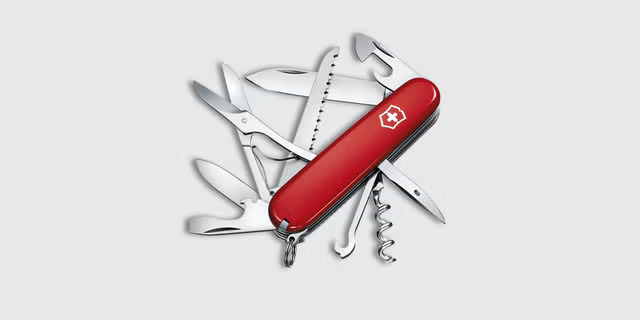
To answer the first question, let us imagine the world as a special type of Swiss knife with agentic elements, in which we are both an element and an operator.
Concerning the evolution of this Swiss knife, let us make a few statements. First, in the past these elements were equipped with only similar essential capabilities that enabled them to thrive. Second, with time, our understanding of the world and the complexity of the social structures that shape our lives have increased almost exponentially and without bound. Third, our capacity to adapt to these changes, limited by our lifespans and mental capacities, has increased only linearly.
These three statements have three immediate consequences. Firstly, that the effectiveness of our similar essential capabilities in guaranteeing survival has significantly declined. Secondly, that since time immemorial, we have improved our chances of survival by collaborating to concentrate the power of our individual capabilities. And thirdly, that this increasing ability to collaborate has allowed us to develop specialization, and consequently has turned the world into a Swiss knife with very different elements.
The world, as a Swiss knife, has evolved (and continues to evolve) from a constitution of many similar elements into one of highly differentiated ones. For the collective, collaboration among these constituents has become even more important for survival. For the individual elements — which each of us are — the ability to operate a Swiss knife that is growing almost exponentially in both size and complexity has become even more essential for thriving.
At first thought, this is frightening. How much time do we have in one mortal life to master the operation of this monstrosity of a Swiss knife?
Upon second thought, one may realize that increasing complexity also means more possible combinations. Isn’t that the beauty of a Swiss knife in the first place? That is, I concede, only another way to read the situation — a more optimistic one, I hope. It is all about the number of ways to think or get things done, and which ones you choose.
In collaborating, the operators of the Swiss knife are in perpetual negotiation. Even if you don’t think of it as such, your visit to the barbershop, just like your final job interview with an HR officer, is a negotiation.
For each negotiation, outcomes can be influenced by the trinity of power, time, and information.
If you are reading this article instead of hosting dinner for world presidents, then you, like me, have little power to speak of. To worsen our shared predicament, there are a billion ways our lives could end even at this moment. We have neither power nor time.
With shrewd activity, you could accumulate power through a slow, delicate, and costly process that comes with its own problems: you pay heavily for power, and once you have it, you become a target for those who want it. It is an endless zero-sum game.
But information? It is abundant and almost always innocent of the sins that plague zero-sum games. Without doubt, it is the most attainable source of leverage in any negotiation.
As both elements and operators, we are perpetually subjects and objects of ongoing negotiations.
In the same way that a call to a banker requesting a loan is dangerous if you know very little about banking, your significantly younger nieces and nephews are at a disadvantage when they ask you to bring them a present from your overseas trip. Many mischievous uncles and aunts buy something cheap and useless and oversell their prudence with an interesting story. Information asymmetries are a source of great leverage, and you can create them endlessly simply by knowing more.
As elements, increasing what we know (either generally or specifically) improves our bargaining position by making us more desirable to others. As operators, increasing what we know (especially in a general sense) improves our bargaining position by enabling us to see more combinations.
There can be endless debate about how much of the specific versus the general one should strive to know. I believe that is a matter best left to personality and circumstance; the right answer is always in flux.
I will only add that you can significantly improve the value of what you know by learning as many seemingly random things as possible. It is a random world in perpetual flux, and the more random things one knows, the more combinations one can make. That often leads to a better bargaining position without even realizing it.
Whenever you hear someone say they “rose to the occasion,” be assured that they are not some powerful shaman from the heavens. They are, in most cases, collectors whose random knowledge allowed them to instantly make a useful connection.
So when do you call the head of the corporate banking division?
One instance might be when you decide to become a corporate raider and need to raise money for your next shenanigan. But beware: if the banker knows more than you about what you are trying to do, the raider may become the raided.
The second question as to when it is best to know is rather simple to answer. Now. Whatever you know compounds; why will a thinking person interrupt compounding?
If all these words have impressed nothing upon you, perhaps just remember this: when the founders of the Communist Party in the USSR made Joseph Stalin their General Secretary, it was an act of spite. Stalin, however, used the fact that he always knew more than everyone else to maneuver himself to the top.
I hope that becomes one of many random facts you gather, and correctly connect, throughout your life.
If we assumed that our broader way of life had anything in common with war, then it will be appropriate to quote Carl Von Clausewitz: “… the realm of the military art extends wherever in psychology our intelligence discovers a resource that can serve the soldier. Just know random stuff, and you might extend your realm.